Legal States
 Available in US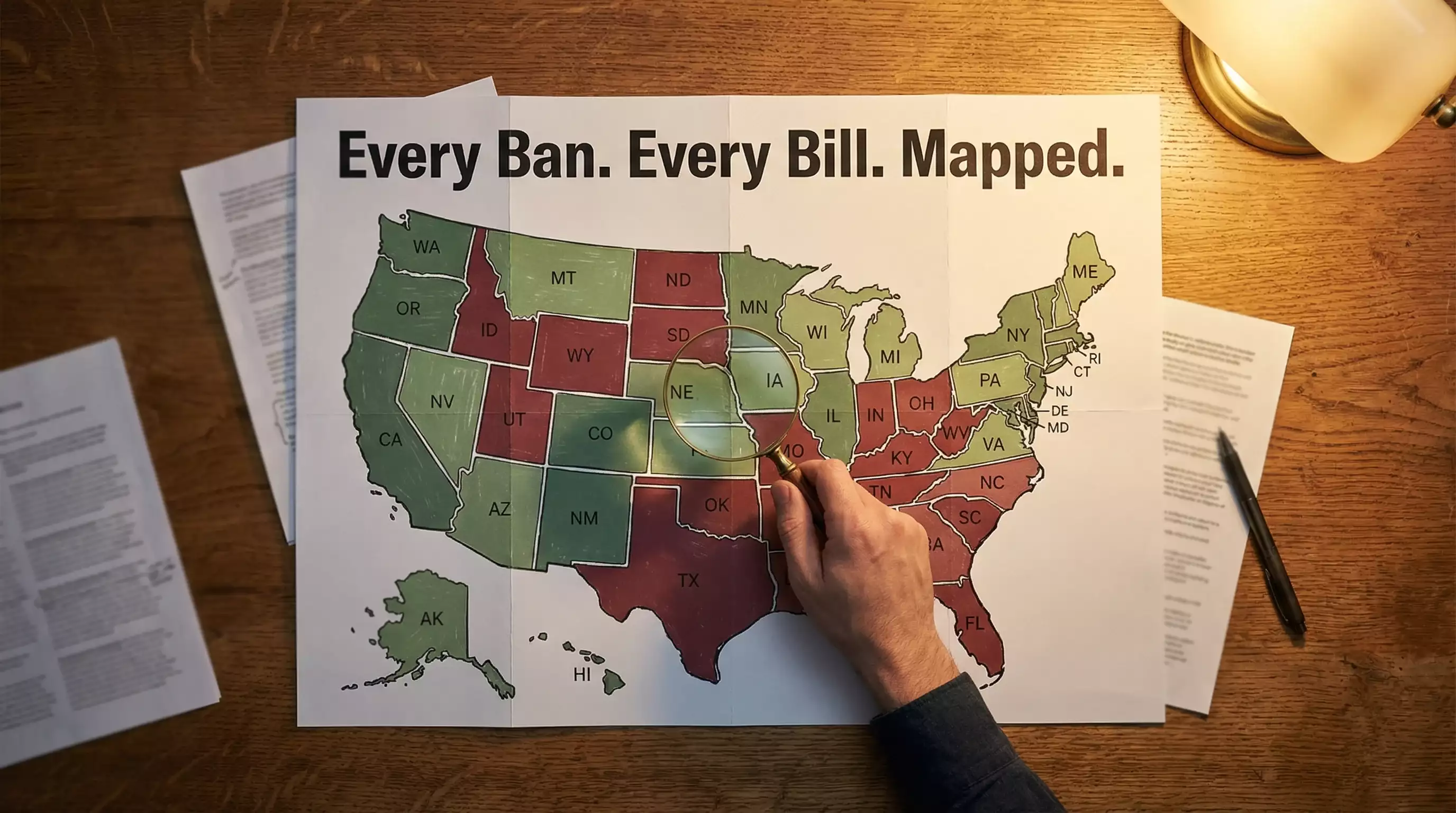
Sweepstakes casino legal states in 2026 are harder to count than they were a year ago — and that is the whole story in a single sentence. What was once a straightforward map (mostly green, a few red dots) has become a patchwork of outright bans, pending bills, attorney general warnings, and enforcement actions that vary not just by state but by the month. This is not a list — it is a legal landscape, and it is shifting under the industry’s feet.
The numbers frame the scale of the shift. Six states passed explicit sweepstakes casino bans during 2025: California, New York, Connecticut, Montana, New Jersey, and Nevada, according to SBC Americas. At least three more — Florida, Maine, and Indiana — have active legislation in the pipeline for 2026. That brings the total count of states that have banned or severely restricted sweepstakes casinos to at least 17, with the number likely to grow before the year is out. For an industry that operated in virtual legal silence as recently as 2023, the velocity of the crackdown is remarkable.
What makes this guide different from a simple “banned vs. legal” checklist is the depth. Every ban has a mechanism — a specific bill, a specific penalty structure, a specific set of actors it targets. The details matter for players who want to understand not just whether they can play, but what happens if the legal ground shifts beneath the platform they are using.
Below, each layer of the legal landscape is mapped: the foundational legal theory that sweepstakes casinos rely on, the states that have rejected it, the bills still working through legislatures, the states where the model remains accessible, and the enforcement actions that signal where regulators are heading next. The goal is not to offer legal advice — it is to give you the most complete, cite-heavy picture of where the industry stands in 2026.
How Sweepstakes Casino Legality Works in the US
Sweepstakes casinos did not emerge from gambling law. They emerged from promotional marketing law — a legal framework that predates the internet by decades. The foundation is simple: a sweepstakes promotion is legal in most US jurisdictions if it meets three conditions. First, entry must be available without a purchase — the “no purchase necessary” requirement. Second, the promotion must have official rules, including odds of winning, eligibility criteria, and a start and end date. Third, winners must be determined by chance (or a combination of skill and chance, depending on the state). These principles govern everything from McDonald’s Monopoly to Publisher’s Clearing House mailings, and sweepstakes casino operators argue that their platforms fall under the same umbrella.
The mechanism works like this: players can acquire Sweeps Coins through free methods — daily logins, mail-in requests (known as Alternative Method of Entry, or AMOE), social media giveaways, and registration bonuses. They can also purchase Gold Coins, a virtual currency with no cash value, and receive Sweeps Coins as a bonus included with the purchase. The operator’s legal position is that players are buying entertainment tokens (Gold Coins) and receiving promotional entries (Sweeps Coins) as a free add-on. Because an entry path exists that requires no payment, the argument goes, the promotion is not gambling.
For years, this framework held up largely because no one challenged it. Sweepstakes casinos were small, niche, and operated below the radar of most state regulators. That changed as the industry grew. When gross revenue hit $10.6 billion in 2024 and the sector overtook regulated iGaming by revenue, the “we’re just a promotion” argument became harder to sustain. State legislators began asking a pointed question: if 90% of the players themselves consider it gambling — as a 2025 AGA-commissioned survey of 2,250 sweepstakes casino users found — then on what basis should the law treat it differently?
The legal challenge centers on the substance-over-form doctrine. Opponents argue that sweepstakes casinos are gambling operations dressed in promotional clothing — that the Gold Coin purchase is functionally a deposit, the Sweeps Coin play is functionally a wager, and the cash redemption is functionally a withdrawal. Supporters counter that the dual-currency model is structurally distinct from gambling because it preserves a free entry path and never requires the player to risk their own money. Both sides can point to existing law to support their position, which is precisely why the fight has moved to state legislatures rather than courtrooms.
The result is a jurisdiction-by-jurisdiction patchwork. Some states have decided the model is illegal. Some have decided it is legal. Many have not decided at all — and in those states, sweepstakes casinos continue to operate in a regulatory gray zone where the absence of a ban is treated as permission, even when no explicit authorization exists.
States That Banned Sweepstakes Casinos in 2025–2026
The wave of bans that hit in 2025 was not gradual. It was a cascade, and California set it off.
California: AB 831
Governor Gavin Newsom signed Assembly Bill 831 into law on October 11, 2025, banning sweepstakes casinos effective January 1, 2026. The bill passed with extraordinary unanimity: 36-0 in the State Senate and 63-0 in the Assembly, as recorded by the California Legislature. Not a single lawmaker in either chamber voted against it. Shawn Fluharty, President of the National Council of Legislators from Gaming States, captured the rarity of that consensus at G2E in October 2025: “They can’t agree on the colour of the carpet” — yet on sweepstakes, the vote was unanimous.
The financial stakes explain the political alignment. According to Eilers & Krejcik Gaming data prepared for the Sweepstakes Gaming Lobby Association, California alone generated an estimated $2.42 billion in sweepstakes sales in 2025 — roughly 17.3% of the entire US market. For a state with no legal online gambling and a powerful tribal gaming lobby, the presence of an unregulated $2.4 billion industry operating on phones was politically untenable.
What makes AB 831 distinctive among state bans is its scope. The law does not stop at operators. It extends criminal liability to vendors: payment processors, geolocation service providers, content suppliers, and media affiliates who facilitate sweepstakes casino operations, as analyzed by ZwillGen. Violations are classified as misdemeanors, carrying penalties of up to $25,000 in fines and up to one year in county jail. This vendor-liability provision is the broadest of any state ban and has forced third-party companies — not just casino operators — to geo-block California users or risk prosecution.
New York: SB 5935
Governor Kathy Hochul signed Senate Bill 5935 on December 5, 2025, making New York the second major market to ban sweepstakes casinos in the same year. The bill, authored by Senator Joseph Addabbo Jr., imposes fines ranging from $10,000 to $100,000 per violation, according to the New York State Senate. The state’s sweepstakes casino market was valued at approximately $762 million in annual sales in 2024 — smaller than California, but large enough to matter.
Addabbo framed the ban as a consumer protection measure, pointing to the absence of the regulatory infrastructure that New York had painstakingly built for mobile sports betting and iGaming: “The guardrails and the safeguards that we painstakingly take efforts to do when we do mobile sports betting or iGaming are not there with most of these sweepstakes casino sites.” — Sen. Joseph Addabbo Jr., D-NY
Connecticut, Montana, New Jersey, Nevada
The remaining four states that enacted bans in 2025 followed different paths to the same destination. Connecticut and New Jersey — both states with established, regulated online gaming markets — moved to protect their existing operators from unregulated competition. Nevada, home to the nation’s largest brick-and-mortar casino industry, had long treated sweepstakes-style games with suspicion and formalized its ban to close remaining gaps. Montana’s ban was driven by concerns over consumer protection in a state with limited regulatory infrastructure for online gaming.
Combined with states that had restricted sweepstakes casinos before 2025 — including Washington, Idaho, and Michigan through attorney general actions — the total count of jurisdictions where the model is banned or effectively prohibited reached at least 17 by early 2026. California’s status as the 17th state is confirmed by legislative records, though the exact count depends on whether one includes states that issued informal AG warnings versus those that passed binding legislation.
Fluharty, speaking at the NCLGS Winter Conference in December 2025, summarized the bipartisan sentiment: “Rarely do we agree on anything as lawmakers, but on this issue, we agree that this represents illegal gambling operations.” — Shawn Fluharty, President, NCLGS
Pending Legislation: FL, IN, ME & More
The 2025 bans were not the end of the legislative push — they were the beginning of a template. Several states have introduced or are actively drafting sweepstakes casino legislation for 2026, and the common thread is that each state has a pre-existing gaming industry with a financial interest in seeing unregulated competitors removed from the market.
Florida is the most closely watched. The state’s gaming landscape is dominated by the Seminole Tribe’s compact and a pari-mutuel industry that has fought for decades over gambling turf. Sweepstakes casinos represent a new, unregulated entrant into a market that has historically been controlled through tribal agreements and constitutional amendments. A bill to ban or regulate sweepstakes platforms has been introduced in the Florida legislature, though its path through committee remains uncertain. Given Florida’s population — the third-largest state — a ban would remove one of the largest remaining player pools from the sweepstakes ecosystem.
Indiana presents a similar dynamic. The state’s commercial casino industry, which includes major national operators, has lobbied for restrictions on sweepstakes platforms that operate without paying the state’s gaming tax. Indiana has a well-established gaming commission with the infrastructure to enforce a ban, making legislative action relatively straightforward once political will aligns.
Maine rounds out the trio of states most likely to act in 2026. The state’s smaller market and less complex gaming landscape could allow a ban to move quickly through the legislature, though the economic impact would be comparatively minor.
The industry impact of these pending bans is already being priced in by analysts. After California’s AB 831 was signed, Eilers & Krejcik Gaming revised their net revenue forecast for the sweepstakes sector downward — from $4.7 billion to $4 billion for 2025 (still representing 16% year-over-year growth), and projected a further 10% decline to approximately $3.6 billion in 2026 under their base-case scenario. The revision marks the first time a major analytics firm has forecast year-over-year contraction in sweepstakes casino revenue — a signal that the regulatory headwinds are no longer theoretical.
Dan Hartman, a former director of the Colorado Division of Gaming and current senior advisor at GMA Consulting, summed up the regulator’s perspective at the NCLGS Winter Conference in December 2025: “The one thing I’ve said all along is you can’t all break in through the backdoor. Companies pay a lot to get licensed and do the things they do in our state.” — Dan Hartman, Senior Advisor, GMA Consulting
Beyond the three headline states, at least a half-dozen other legislatures have introduced study bills or resolution language targeting sweepstakes casinos. These measures may not result in immediate bans, but they signal an expanding awareness among lawmakers that the issue requires attention. The NCLGS has made sweepstakes regulation a standing agenda item, which increases the likelihood that model legislation — a standardized bill template that states can adopt with minor modifications — will circulate among legislative bodies in 2026 and 2027.
States Where Sweepstakes Casinos Are Legal
As of early 2026, sweepstakes casinos remain accessible in approximately 33 states — though “accessible” and “explicitly legal” are not the same thing, and that distinction is worth understanding before you sign up.
In most of these states, sweepstakes casinos operate not because the legislature passed a law authorizing them, but because no law explicitly prohibits them. The model sits in a regulatory gap: the state’s gambling statutes were written before sweepstakes casinos existed, and the promotional sweepstakes framework the operators rely on has not been tested or challenged by the state’s attorney general. For players, this means the platform works, the games load, and redemptions process — but the legal foundation is the absence of prohibition, not the presence of permission.
A handful of states occupy a middle ground that is worth flagging. Some attorneys general have issued informal warnings to sweepstakes operators — not cease-and-desist letters, but advisory notices indicating that the state is monitoring the industry and may take action. These warnings do not have the force of law, but they signal regulatory interest that could escalate. Players in these states face the lowest immediate risk of disruption, but the medium-term outlook is less certain.
States with no regulated iGaming market — which includes the vast majority of the country — tend to have the most permissive environment for sweepstakes casinos. This is not because these states approve of the model; it is because there is no established gaming industry lobbying for restrictions and no gaming commission with jurisdiction over online play. Texas, Ohio, Georgia, Illinois, and dozens of other large-population states fall into this category. Sweepstakes casinos can operate freely there, not because they have been welcomed, but because no one with legislative authority has decided to push them out yet.
States with active regulated iGaming markets present the opposite dynamic. New Jersey, Connecticut, and Nevada — all of which banned sweepstakes casinos in 2025 — are also states where licensed online casino operators pay substantial gaming taxes and have a direct financial interest in eliminating unregulated competition. Pennsylvania and Michigan, which have the two largest regulated iGaming markets after New Jersey, have not yet passed sweepstakes bans but have both seen regulatory activity and AG-level inquiries. If any currently-legal state is likely to ban sweepstakes casinos next, it is one where regulated operators already have a seat at the table.
For players, the practical advice is simple but often ignored: verify your state’s current status before creating an account or accumulating a balance. The legal landscape is moving fast enough that information from six months ago may already be outdated. Check your state attorney general’s website for any advisories or actions related to sweepstakes casinos, and pay attention to local news coverage of gaming legislation. The platforms themselves are not always reliable sources on their own legality — operators have a financial incentive to keep accepting players until a ban is formally enforced.
Enforcement: Fines, C&D Letters & Operator Penalties
Bans are one thing. Enforcement is another. And in 2025, enforcement escalated from scattered warnings to coordinated, financially painful action.
The broadest measure of the shift is volume: state regulators and attorneys general issued more than 100 cease-and-desist letters to sweepstakes casino operators during 2025, according to iGaming Business. States that sent C&D notices included Arizona, Michigan, West Virginia, Louisiana, and Maryland, among others. In most cases, the letters demanded that operators stop accepting players from the state and remove access to their platforms. Compliance was mixed — some operators geo-blocked the relevant states immediately, while others continued operating until a formal legal deadline forced their hand.
The financial penalties have been even more pointed. High 5 Games, one of the larger sweepstakes casino operators, paid $24.9 million in fines to the state of Washington and an additional $1.5 million to Connecticut for violations related to its sweepstakes gaming operations, as reported by iGaming Business. The Washington fine alone represents one of the largest penalties ever levied against a sweepstakes casino operator — and it sent a clear message to the rest of the industry that enforcement actions will carry real financial consequences, not just symbolic slaps.
The pattern of escalation follows a recognizable arc. First, an attorney general or gaming commission issues a public advisory — a nonbinding statement that sweepstakes casinos may violate state law. Second, C&D letters go out to specific operators identified as serving players in the state. Third, if operators do not comply, the state moves to formal legal action: fines, injunctions, or criminal referrals. California’s AB 831, with its vendor-liability provisions and misdemeanor classification, represents the most aggressive endpoint of this arc to date.
For operators, the enforcement trend has forced a strategic calculation. The cost of fighting a state ban in court — with uncertain outcomes and ongoing negative publicity — increasingly outweighs the revenue from that state’s player base. Most major operators have chosen to comply with bans and geo-block restricted states rather than litigate. Smaller operators, particularly those based offshore, have been less consistent in their compliance, which creates an additional risk for players: the platform you are using may not be following the law even in states where bans are in effect.
The enforcement picture also reveals something about the political direction of the industry. When state regulators allocate resources to investigate and penalize sweepstakes operators — resources that could be directed elsewhere — it signals institutional commitment to the position that the model is illegal gambling. Every fine paid, every C&D served, and every operator that geo-blocks a state is another data point in a trend that points in one direction: tighter restrictions, more states, more enforcement. Players who assume the current environment will remain static are making a bet that the data does not support.